
Quitman County Release Meanings
“Released” should describe the end of a particular custody event, not merely a name that disappeared from a screen. For a Quitman County booking, the Sheriff's Office can identify the booking, actual holder, recorded disposition, and destination. A court order may explain why custody was supposed to change. The holding agency's movement record is the better source for when it actually changed. State custody belongs to the Mississippi Department of Corrections, commonly called MDOC. Federal prison and immigration custody require separate federal systems.
The destination matters. Bond, recognizance, time served, dismissal, and a court-ordered discharge may lead to the community. Transfer to MDOC, another county, a federal authority, or immigration custody ends one agency's control while another continues it. Parole and Earned Release Supervision, or ERS, permit a person to live outside a prison under conditions. They are not the same as full sentence discharge. A clear Quitman County release record should preserve the agency's own disposition label instead of turning every departure into an unconditional release.
- Time served
- Release after the required local custody term or credit has been satisfied.
- Parole
- Conditional liberty during a sentence, subject to state supervision.
- ERS
- Earned Release Supervision, with inmate status and MDOC jurisdiction continuing in the community.
- Discharge
- The legal end of the identified sentence or corrections authority, as shown by the proper record.
- Detainer
- A request or hold from another authority that can block a community release.
Quitman County Release Paths
Quitman release checks work best when the event is sorted by type before any search begins. The same absent name can point to very different outcomes. The Sheriff's Office should explain its disposition code and name the next custodian, if any. A court file can then confirm the order behind a bond, dismissal, sentence, revocation, or other legal change.
| Recorded event | What it can mean | Next source |
|---|---|---|
| Bond or recognizance | County physical custody ended subject to the case and any conditions. | Sheriff release record and issuing court order |
| Time served or discharge | The applicable local custody term or order ended. | Sheriff timestamp and court disposition |
| Transfer | Custody at one site ended, but custody continued elsewhere. | Destination agency and transfer record |
| Parole or ERS | Physical prison custody ended while MDOC control continued. | MDOC inmate/parolee records and written release document |
| Federal or immigration hold | A federal authority may have assumed custody. | BOP, ICE, federal docket, or USMS confirmation |
A judge's order time and a jail exit time can differ. Bond processing, an unresolved hold, or transport arrangements may keep a person in custody after an order is filed. When timing is in dispute, request both the court instrument and the actual movement or release log. Each answers a different question.
Quitman County Release Record Fields
The most useful county record links a person to one booking and states exactly how that custody episode ended. Quitman has no verified online booking record with a release field, so these details should be named in a focused request. Asking for the existing record is important. Mississippi access law does not require an office to design a new custom report if the requested compilation is not kept in the ordinary course.
| Field | What it shows |
|---|---|
| Full name and identifiers | Connect the event to the intended person and help resolve aliases. |
| Booking number | Ties the release to one arrest or admission episode. |
| Booking date and time | Marks the start of the recorded custody event. |
| Release date and time | Records when the holding agency ended physical custody. |
| Disposition or reason | States the agency's code or description for the movement. |
| Releasing authority | Identifies the court or agency behind the change. |
| Destination | Distinguishes community release from transfer to another custodian. |
For state custody, Mississippi law provides a distinct written release or discharge document under §47-5-157. It can include the person's name, offenses, sentence term and date, sentencing county, commutation when applicable, a physical description, and a discharge plan. That signed state document is stronger proof of an actual MDOC event than the public search's prospective “Tentative Release Date.”
Request Quitman County Release Records
Direct a narrow county request to the Quitman County Sheriff's Office. The official contact is Sheriff Oliver Parker Jr., P.O. Box 365, Marks, MS 38646, telephone 662-326-3131. The corroborated physical location is 233 Chestnut Street. No official records email, web request form, local fee schedule, or records hours were verified, so call first and ask for the current submission method.
- Give the full legal name, aliases, date of birth if known, approximate booking range, and booking number if available.
- Request the existing booking and release record, including date and time, disposition, authority, and transfer destination.
- Ask which facility physically held the person and whether that facility keeps the movement timestamp.
- Request electronic production, segregable nonexempt portions, and an advance itemized cost estimate.
- If anything is denied, ask for a written response citing the specific exemption.
Mississippi's Public Records Act allows actual search, review, duplication, and mailing costs, calculated at the lowest-paid competent staff level. Advance payment may be required. No fixed Quitman County copy charge was found. A request should not promise a free record or invent a local amount.
Can an old record still exist if it is not online? Yes. Public web display and legal record retention are different. Ask the custodian which approved retention schedule applies to the booking or release record.
Quitman Release Records Access Law
Mississippi Title 25, Chapter 61 governs public-record access. If an agency has no reasonable written procedure, §25-61-5 calls for access within one working day. A procedure cannot set production or denial later than seven working days. If production cannot occur by then, the agency must explain the delay in writing and set a date, generally no later than fourteen working days without an agreement. Exempt content should be redacted while releasable portions are produced.
Section 25-61-7 limits charges to actual cost. Section 25-61-3 includes photographs in the broad public-record definition, though exemptions and lawful redaction can still apply. A denial must identify a specific exemption in writing. The statewide three-year rule for keeping denial files is not the retention term for the underlying jail record.
Expungement means a qualifying court record is removed or restricted under an order and governing law. Sealing also limits access. Neither is the same as release, and a failed search does not prove either one. Quitman Circuit Court is the source for an applicable order. Juvenile, sealed, and expunged material should not be reproduced when access is restricted.
Note: Ask for a written exemption citation when content is withheld, while allowing the office to redact protected parts.
Where Quitman Inmates Are Housed
A Quitman-specific 2001 law authorizes the county to contract for inmate housing with neighboring counties or correctional operators instead of maintaining its own jail. The law does not identify a current contractor. It therefore supports a question, not an assumption: which agency physically held the person during this booking?
Quitman officials may retain the arrest and court-linked material while another facility holds the movement log and actual release timestamp. Ask who booked the person, who housed the person, and which agency entered the final disposition. Departure from the holding site can also be a transfer. The Quitman County jail release route explains that local chain in more detail.
Find Quitman County Released Inmates
No verified current Quitman County roster or recent-release page was found. A released person also tends to leave a live custody list. The search must begin with the last known custodian, then move according to the answer. Keep exact names, aliases, birth date, booking range, charge, booking number, and last known facility close at hand.
- Call the sheriff to verify the booking, identify the actual housing agency, and classify the event as release or transfer.
- Request the existing county release record and the housing facility's movement record when those are held by different offices.
- Use the appropriate Justice or Circuit Court file to confirm the bond, dismissal, sentence, or other legal order.
- If transfer to MDOC occurred, search MDOC by name or ID, then check the parolee search and request written release proof.
- Use Mississippi VINE for a status or notification check, subject to the unverified Quitman jail participation limit.
- For federal or immigration custody, switch to BOP, ICE, the federal docket, or USMS rather than the county path.
A negative search is limited evidence. Record the spelling, identifier, system, and date checked. Then state that no public match was found in that system, not that the person was released or never held. An alias, data lag, transfer, restriction, old booking, or full discharge can all produce no result.
Note: Search the most specific identifier available before relying on a common name or a photograph.
MDOC Quitman Release Search
The Mississippi Department of Corrections presents separate inmate and parolee searches. Its inmate form accepts first name, last name, or MDOC ID. A detail result can display identity data, photograph, entry and location data, offenses, sentencing counties, sentence dates, and the exact field “Tentative Release Date.” The research did not verify a universal public “Released” or “Discharged” label, so the search should not be described as a complete archive of former state inmates.
| MDOC channel | Search fields | How to read it |
|---|---|---|
| Inmate Search | First name, last name, MDOC ID | Location and tentative date describe state custody or its projected path. |
| Parolee Search | Name, MDOC ID, city, county | A match supports conditional community parole; Flat Time Date is not necessarily the prison exit date. |
| MDOC records request | Name, MDOC ID, county, date range | Request the written release/discharge and time-computation record. |
The official MDOC entry screen shows the two public search routes. Open the MDOC source before reviewing the captured interface.
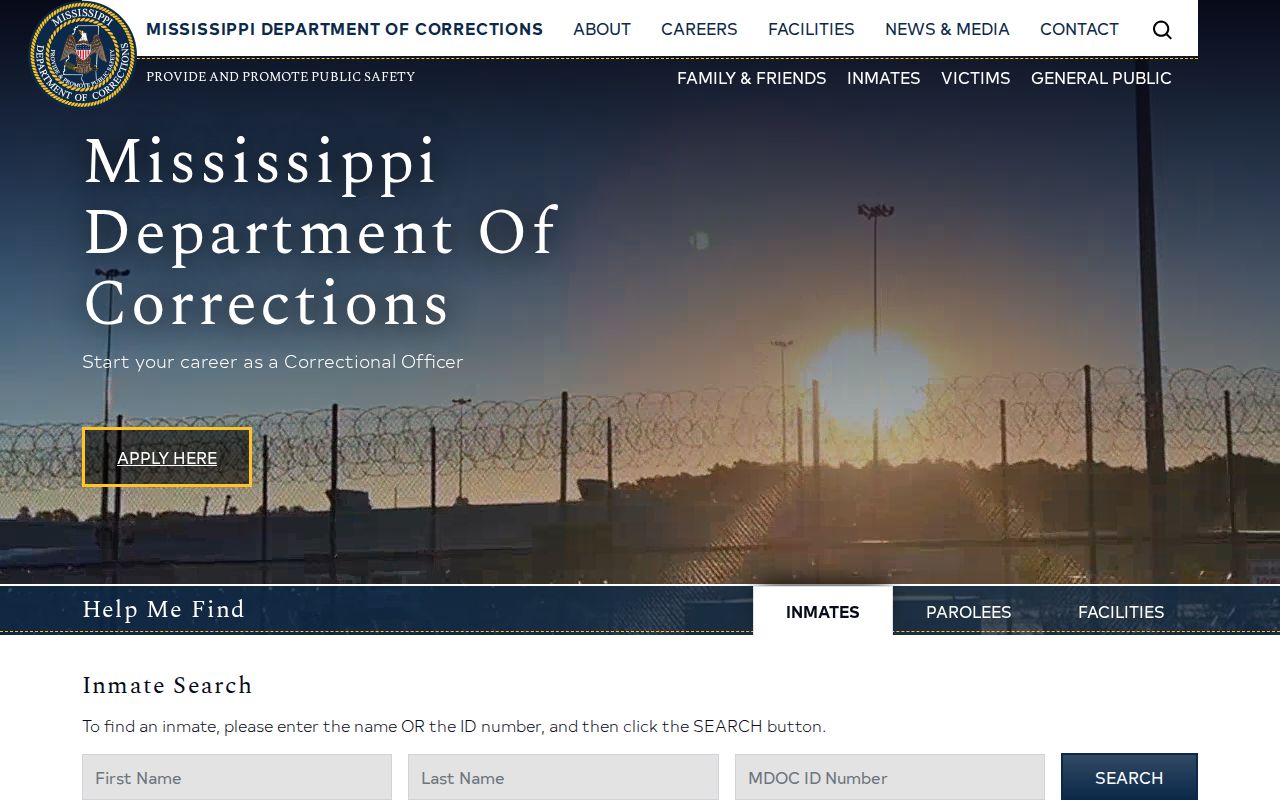
The separate routes matter because a parolee can be out of prison while still under state supervision. ERS is another conditional state status. For actual past release or full discharge, use the written MDOC record rather than treating a tentative date as proof.
Quitman Release Orders After 2024
Quitman Circuit Court joined Mississippi Electronic Courts on April 22, 2024. That creates a local access split. Recent electronic felony dockets may be available through MEC, while older and nonelectronic files may still require the Circuit Clerk at 220 Chestnut Street, Suite 4, Marks, telephone 662-326-8003. Verified Circuit Clerk hours are 8 a.m. to 5 p.m.; those hours should not be applied to other county offices.
MEC flags can include CLOSED, EXPUNGED, SEALED, Probation, PRS Violation Pending, and warrant indicators. They add context but do not record the sheriff's physical release time. A bond or release order authorizes a change; the custodian's log shows whether and when it occurred. Justice Court is the route for its own bond and initial-order records.
The official Quitman court page lists the local court contacts. The captured page helps distinguish the Circuit and Justice Court routes.
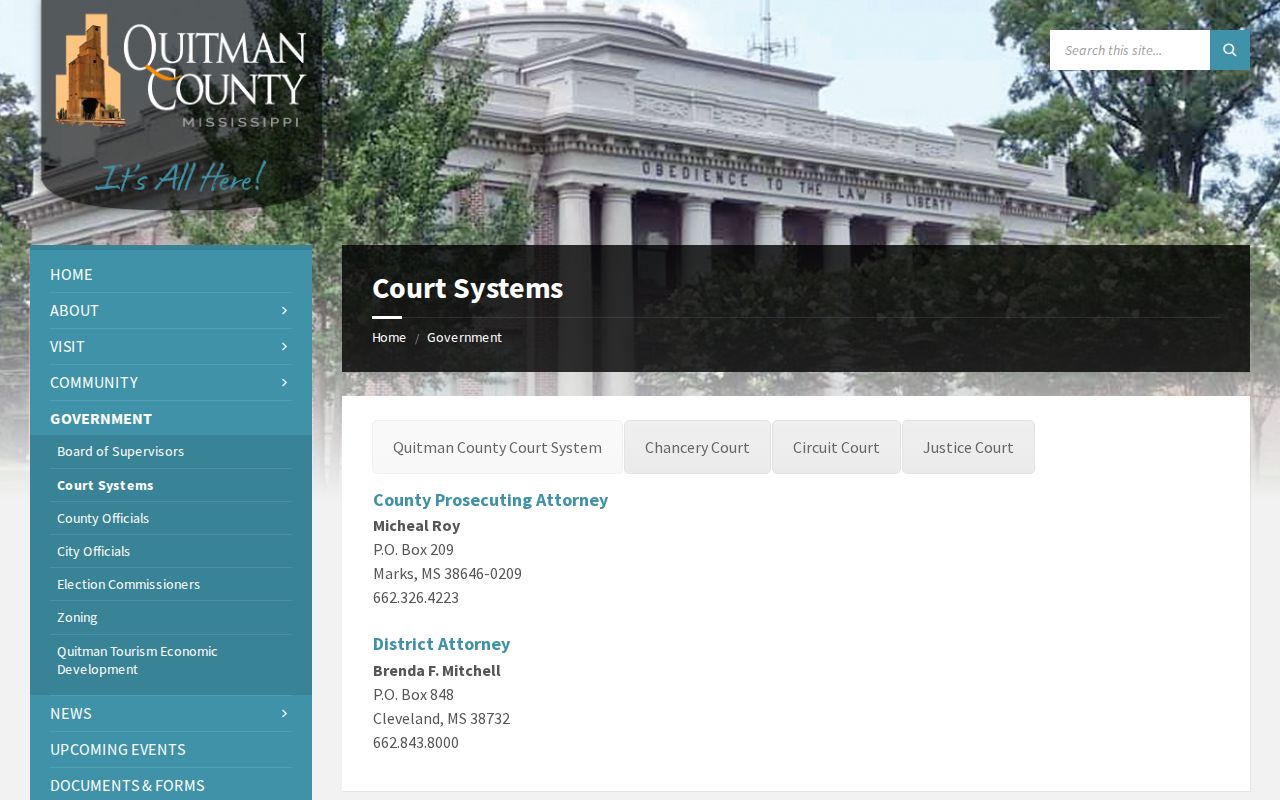
The court record should be paired with the sheriff, MDOC, or other custodian's event record whenever actual exit time matters.
Quitman Historical Custody Lists
Mississippi Rule of Criminal Procedure 8.5(c) produces a distinctive local record. Before a Circuit Court term, custodial officials provide a list of held felony defendants, charges, and latest custody dates to court officials, and the Circuit Clerk maintains it. Archived Quitman copies are dated snapshots. A 2019 list showed names, charges, and arrest dates but no release time, reason, or photograph.
These lists can establish that a named person appeared in custody for a court term. They cannot establish a later release. The archive itself warns that people may have been released since each list was made. Pair the old list with a later release record, custody-changing court order, or MDOC/federal result. Absence also proves little because the list is not an all-bookings ledger.
Note: A dated custody list is historical evidence, not a current roster or rolling Quitman County release feed.
Match Quitman Release Identities
A sound release check reconciles stable identifiers before connecting a custody event to a person. Names can be shared. Spellings and aliases can vary. Date of birth, booking number, MDOC ID, charge, sentencing county, booking period, and physical descriptors help separate similar results. A photograph may help, but it should not stand alone.
The Mississippi Sex Offender Registry gives a concrete warning: names, birth dates, and appearance cannot conclusively identify a person, and fingerprints are required for positive identification. The registry applies only to qualifying registrants. It is not a general Quitman County release list or proof of present custody. Its lesson here is narrower: compare more than one identifier and correct a mismatch through the originating agency.
Note: Registry presence has a narrow statutory basis and should never be treated as a general custody or release result.
Quitman Supervision After Release
Parole, probation, ERS, and post-release supervision describe different legal relationships. The State Parole Board decides parole matters, while MDOC manages community supervision. The MDOC parolee search accepts name, ID, city, and county. A Quitman match may show the supervising officer and Flat Time Date, but that endpoint is not necessarily the date physical imprisonment ended.
The Quitman Probation & Parole Office is at 279 East Main Street in Marks, telephone 662-326-8910. It is the local routing point once state community supervision is indicated. An absconder or warrant flag does not prove present jail custody, and a technical violation can produce a new confinement event. The Quitman County Probation & Parole page sets out the verification path.
Quitman Release Alerts and Transfers
Mississippi VINELink supports offender status checks and phone, email, SMS, or TTY notification through the state route. MDOC coverage is supported, but official research did not independently confirm Quitman County jail participation. Check the live agency selector. If Quitman is absent or a name yields no match, use the sheriff and court channels. VINE is a status and alert tool, not a full historical release certificate.
Federal systems answer narrower questions. The BOP Inmate Locator covers federal inmates from 1982 forward and can display a release date or “Not in BOP Custody.” That phrase means only that BOP no longer holds the person. ICE's locator concerns immigration detention; no result does not prove release. A federal pretrial defendant may be held for the U.S. Marshals Service in a contract facility, so the federal docket or USMS confirmation may be required.
Note: Transfer ends custody at one agency but does not prove that all county, state, federal, or immigration custody ended.
Quitman Release Sources Compared
Each source should be used for the fact it actually records. A failed live search is only a lead. An affirmative agency status is stronger, a court order explains legal authority, and a custodian's movement record best documents the completed physical event.
County custody
Call the sheriff, identify the housing facility, and request the release or transfer record. No public Quitman roster was verified.
State custody
Use MDOC inmate and parolee searches, then request the signed release/discharge record for proof of an actual state event.
Court authority
Use Circuit or Justice Court for orders and disposition. Do not treat the order timestamp as the jail exit timestamp.
Federal custody
Use BOP for sentenced federal custody, ICE for immigration detention, and the federal docket or USMS for pretrial movements.
Quitman County Release Facilities
Four facilities are verified in or geographically tied to Quitman County, but they do not share one search system. The sheriff/county-jail route handles county bookings. The other three are MDOC operations or state-prison property, so state offender, parolee, VINE, and records channels apply.
- Quitman County Sheriff's Office / County Jail: ask the sheriff where the person was housed and whether the event was community release or transfer.
- Quitman County Community Work Center: use MDOC because departure can mean transfer, ERS, parole, or discharge.
- Quitman County Technical Violation Center: verify whether the person returned to supervision rather than completing the sentence.
- Mississippi State Penitentiary at Parchman: use MDOC, VINE, and State Parole Board channels, not a Quitman sheriff search.
Two distinct MDOC functions share the Camp B Road address in Lambert: the Community Work Center and Technical Violation Center. That does not make them one custody category. Parchman's geographic association with Quitman County also does not make a state prisoner a county-jail inmate.