
Quitman TVC Release Paths
The Quitman County Technical Violation Center handles a state-corrections function tied to supervision violations. A person can enter confinement there during an existing parole, probation, post-release supervision, or similar state case. When that confinement ends, the person may return to community supervision. Physical release from the center does not necessarily end the underlying sentence, the conditions imposed by a court or Board, or MDOC supervision.
A different outcome is also possible. MDOC may transfer the person to another state placement, a court may change the controlling order, or the sentence may reach a lawful endpoint. Each needs its own label. A location change identifies movement. A parolee entry identifies conditional community supervision. A written release or discharge record can establish the event MDOC recorded. None should be replaced by the vague phrase “no longer there.”
| TVC outcome | Record to check | What remains possible |
|---|---|---|
| Return to supervision | MDOC record and local supervision office | Conditions and sentence continue |
| State transfer | MDOC location and movement record | Physical custody continues elsewhere |
| Court-directed change | Court order plus MDOC execution record | Processing may follow the order |
| Final discharge | Written MDOC release/discharge document | Other unrelated legal matters are not resolved by it |
Confirm Quitman TVC Release
Begin with the official MDOC Inmate Search. The form accepts a first and last name or an MDOC ID. An ID is the safer starting point. When a name produces more than one result, compare the birth date, physical description, photo, offenses, sentencing county, and sentence dates before choosing a record.
- Open the exact MDOC detail and note the current location, location-change date, and Tentative Release Date exactly as labeled.
- Use the MDOC Parolee Search with the same ID or name. City and county can narrow a search to Quitman.
- Compare the parolee county, supervising officer, and Flat Time Date with the inmate entry. A flat-time date is not always the date of release from the center.
- Contact the Quitman Probation & Parole Office for local routing when the record points to community supervision.
- Request MDOC's written release/discharge record if the public results do not state the event or if proof of the past transition is needed.
A return to community supervision is a release from the center, not an unconditional end to the case.
The Quitman County release lookup distinguishes this state path from a county-jail booking record. The sheriff is not the source for a Technical Violation Center release unless a separate county custody event also exists.
Note: Record both the TVC exit and the supervision status that follows, since they answer different custody questions.
Quitman TVC Contact Route
MDOC separately classifies the Technical Violation Center in its facilities directory. The research places it at the same Camp B Road location and telephone as the Community Work Center. No distinct TVC fax or public office hours were verified, so the shared information should not be expanded beyond the source.
Quitman County Technical Violation Center201 Camp B Road
Lambert, MS 38643
Phone: 662-326-2133
Hours: confirm directly
Call to confirm the correct unit before visiting or directing a facility question. For a release record, use the MDOC GovQA portal or MDOCRecordsDepartment@mdoc.state.ms.us. Identify the full name, MDOC ID, sentencing county, and approximate TVC dates. Ask whether the exit returned the person to supervision, transferred the person, or marked another release status.
No facility-specific fee was found. Mississippi public-records law permits charges tied to actual search, review, duplication, and mailing costs. Request electronic production and an advance itemized estimate. If a portion is withheld, ask for the segregable nonexempt record and the statutory reason for the withholding.
Quitman TVC Facility Type
The Quitman operation is a state technical-violation center run by MDOC. It should not be described as the Quitman County jail, a general pretrial lockup, or the same program as the adjacent Community Work Center. Its role is tied to a violation during an existing supervision matter. That setting explains why a release can restore community placement without ending the sentence.
A technical violation is a breach of supervision conditions rather than a label for a new conviction. The precise allegation and legal action belong in the supervision and court records. Confinement at the TVC can be a new custody episode within the old case. A warrant or violation flag alone does not prove the person is now physically confined, just as departure from the TVC does not prove full discharge.
The research did not establish a capacity, public release schedule, gate procedure, transportation arrangement, or property-pickup process. It also did not verify public lobby hours. Those local facts are omitted and should be confirmed directly for a specific person.
Quitman Release Supervision Office
Quitman County has a dedicated MDOC Probation & Parole Office in Marks. This is the local routing layer when a TVC departure returns someone to supervision. The office can help direct a status inquiry, but the research does not promise that nonpublic reporting details, conditions, schedules, or another person's private case information will be disclosed by telephone.
Quitman Probation & Parole OfficeCommunity Corrections Director Tony P. Harris
279 East Main Street
Marks, MS 38646
Phone: 662-326-8910
Fax: 662-326-8514
Use the public parolee result first when possible. Provide the MDOC ID and the exact location/status terms from that record. Ask which office can verify whether supervision is active and whether the TVC confinement ended. For an official historical record, follow with the MDOC request rather than relying on a phone summary.
Note: The official office page names the director and contact details, but it does not establish a public walk-in schedule in the research.
Two Quitman State Facilities
The Quitman County Community Work Center and Technical Violation Center share the Camp B Road address in Lambert. MDOC's directory lists them separately. That is not a minor naming issue. The work center reflects community-confinement programming, while the TVC is tied to technical-violation custody. A person-specific record should name which operation was involved.
The official MDOC directory provides the classification evidence. It does not supply the release reason. The screenshot below shows the separate directory treatment.
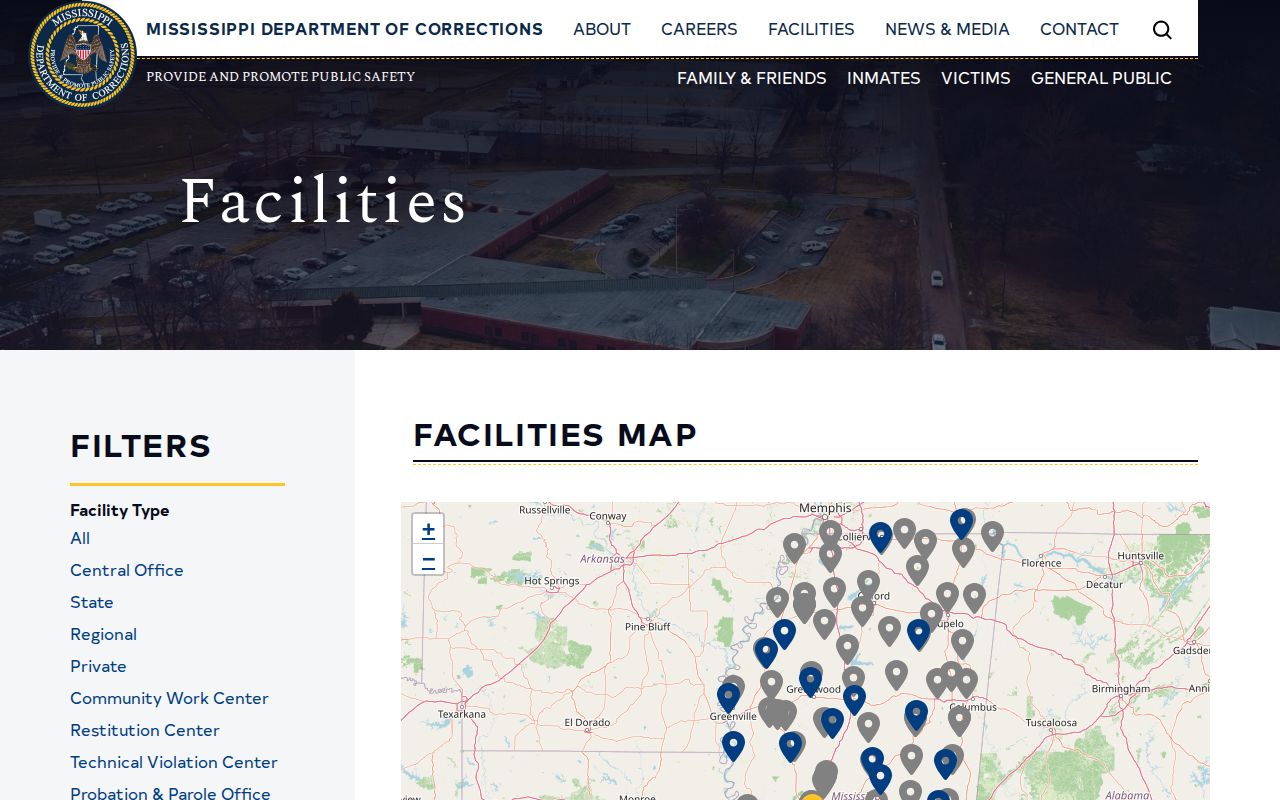
The next step is always the matching offender, supervision, or written movement record, which connects the facility name to the person's status.
Note: The shared Lambert address does not make CWC and TVC placements legally interchangeable in a release record.
Read Quitman TVC Status Terms
MDOC's public inmate detail uses Tentative Release Date. Treat it as a calculation rather than a completed exit. Sentence credits, court amendments, multiple sentences, forfeited earned time, detainers, classification, and an approved residence can change the projected path. The public record may also show a location-change date that differs from the release date a caller expects.
The parolee system supplies another view. It can show a supervising officer, county, and Flat Time Date. A parolee match is strong evidence of conditional community status at the time reflected, but the flat-time field is a sentence endpoint. It may differ from the day TVC confinement ended. An absent parole result does not rule out probation, ERS, past supervision, or a fully discharged record.
- Technical violation
- An alleged breach of supervision terms, distinct from proof of a new conviction.
- Absconder
- A supervision status indicating authorities believe the person failed to remain available or compliant.
- Flat Time Date
- A sentence endpoint shown in parole data, not necessarily the facility exit date.
- Discharge
- The recorded completion of the sentence or supervision at issue.
Quitman TVC Release Record
For firm proof, request the written document described by Mississippi Code section 47-5-157. The statute calls for a signed and sealed writing when an offender is discharged or released on parole, pardon, or another lawful ground. Its listed contents can include name, offenses, sentence term and date, sentencing county, any commutation, a physical description, and a discharge plan.
Ask the records office to define the event. Was it release from TVC confinement back to supervision, transfer to another state location, parole, ERS, or final discharge? Request the date attached to that event and any releasable movement or time-computation material needed to understand it. Keep the official label rather than turning every change into “released.”
If MDOC and a court entry show different dates, both may be correct for different steps. An order can authorize a change before MDOC finishes processing. A warrant or violation flag can also remain a legal indicator without proving present custody. The actual custodian's record establishes physical movement, while the court or supervision record explains the authority.