
Quitman CWC Release Paths
The Quitman County Community Work Center is an MDOC community-confinement operation, not the Quitman County pretrial jail. That difference controls the lookup. A person leaving the center might enter Earned Release Supervision, commonly shortened to ERS, or another form of community supervision. The person might also transfer within MDOC. A final discharge is another event altogether. The county sheriff does not create the controlling state release record for these movements.
Physical departure should therefore be described with care. ERS lets an eligible person serve part of a sentence outside prison while retaining inmate status and remaining under MDOC jurisdiction. Parole is conditional liberty approved through the state parole process. A transfer changes location but does not end custody. Full discharge ends the state sentence and supervision reflected by the discharge record. The public inmate and parolee searches can show parts of this path, but the signed state release or discharge document is stronger proof of what MDOC authorized.
| Possible CWC event | Best place to verify | What it does not prove |
|---|---|---|
| ERS placement | MDOC inmate detail and supervision office | Full discharge from MDOC |
| Parole | MDOC parolee search and Board record | Unconditional sentence completion |
| Transfer | MDOC location and movement record | Release to the community |
| Final discharge | Written MDOC release/discharge record | That every old public copy vanished |
Confirm Quitman CWC Release
Start with the official MDOC Inmate Search. It accepts a first and last name or an MDOC number. The verified detail view can show identity data, a photo, entry date, current location, location-change date, sentence and offense details, sentencing county, and a Tentative Release Date. That label is a forecast. It is not a statement that the person has already left Quitman CWC.
- Search by MDOC number when it is known. If using a name, compare birth date, physical details, conviction county, and offense data before treating a result as a match.
- Read the current location and its change date. An ERS location can mean the person left a prison setting while still remaining an MDOC inmate.
- Check the MDOC Parolee Search by name or ID. City and county can narrow the result to Quitman.
- Ask the Quitman supervision office to route a status inquiry when a parole, probation, or ERS link appears. Do not assume private reporting details are available by phone.
- For proof of a past event or full discharge, request the written release/discharge document and identify the person by full name, MDOC ID, sentencing county, and approximate dates.
A Quitman CWC location change is not, by itself, proof that MDOC jurisdiction ended.
The broader Quitman County released-inmate search path explains how state custody differs from a sheriff booking. That distinction prevents a county call from being treated as the final source for an MDOC movement.
Quitman CWC Records Contact
MDOC lists the work center at Camp B Road in Lambert. The official facility page supplies the telephone and fax, but the research did not verify public office hours. Call before making an in-person trip. Routine facility contact can help identify the right unit, while a formal records request should go through MDOC's public-records route.
Quitman County Community Work Center201 Camp B Road
Lambert, MS 38643
Phone: 662-326-2133
Fax: 662-326-6298
Hours: confirm directly
For a firm state record, use the MDOC records portal or write to MDOCRecordsDepartment@mdoc.state.ms.us. Ask for the written release or discharge record under Mississippi Code section 47-5-157, the relevant time-computation or release-date material, and an electronic copy if available. An exact request reduces identity mistakes and helps the records staff locate the right sentence file.
Mississippi public-records law allows an agency to charge its actual search, review, duplication, and mailing costs. No fixed Quitman CWC fee was verified. Ask for an advance itemized estimate and for nonexempt portions if part of the record must be withheld. A denial should identify the specific exemption in writing.
Note: No public CWC records hours or fixed release-record fee was verified, so confirm both through MDOC before submitting.
Quitman CWC Facility Role
The official Quitman CWC page and the state facilities directory identify this operation separately from the Quitman County Technical Violation Center. The two functions share the same Camp B Road address, yet they should not be merged in a search. The work center is a community-confinement facility within MDOC. The Technical Violation Center serves a different state-corrections role tied to supervision violations.
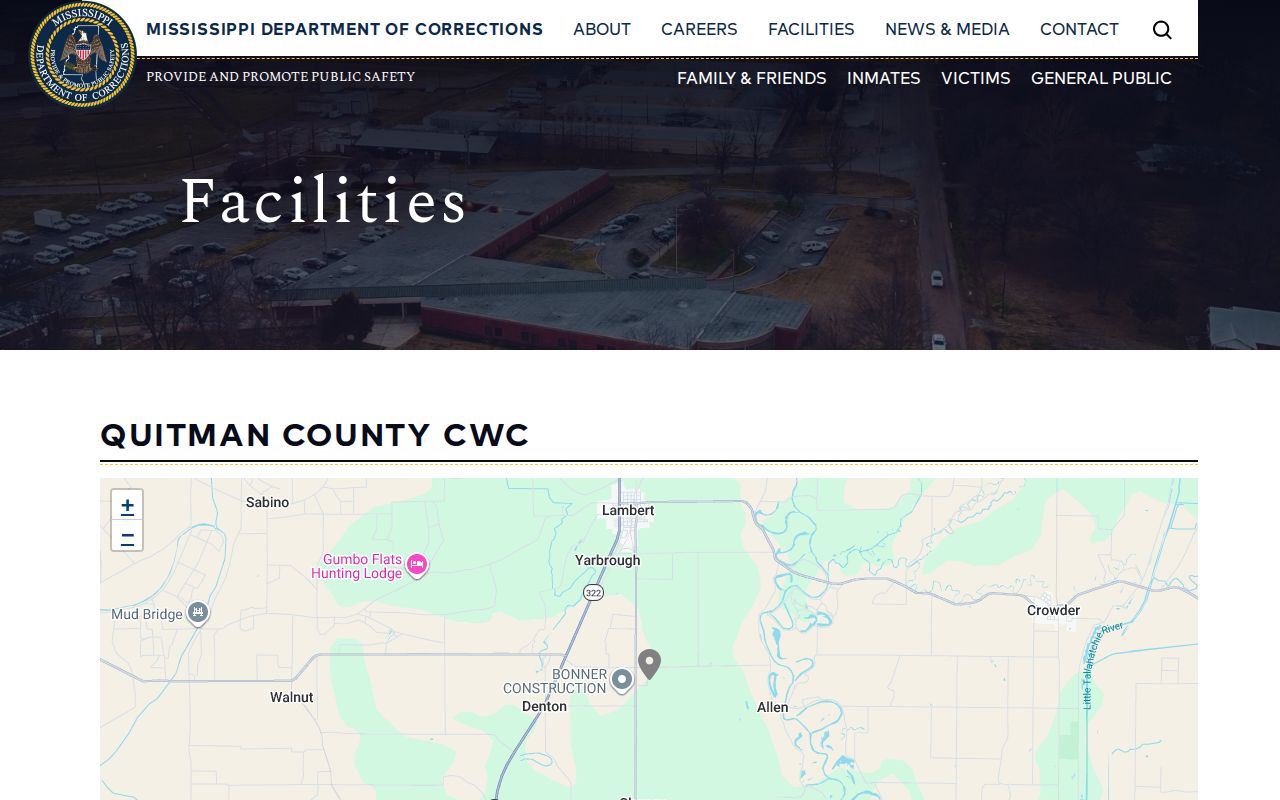
The official facility capture confirms the CWC identity and contact route used for a Quitman County release inquiry.
This separation matters after a person leaves. A CWC departure may reflect movement toward work or community supervision. A departure from the Quitman County Technical Violation Center may return a person to an existing supervision term after a confinement episode. Neither event should be reported from the name of the street alone. Confirm the facility classification, MDOC number, current state location, and the legal status attached to the movement.
The research found no sourced capacity figure suitable for a stat block. It also did not establish public lobby hours, release-gate practices, transportation, property pickup, or a standard departure time. Those details should be obtained from the facility for a specific event rather than inferred from a general directory.
Two Quitman Release Operations
Quitman County has an unusual state-corrections layout. MDOC lists the Community Work Center and a separately classified Technical Violation Center at one Lambert address. A search result that says only “Quitman” or shows Camp B Road may not reveal the legal nature of the placement. The facility name and the status fields carry more meaning than the shared location.
The MDOC facility directory displays the distinct classifications. That official distinction is the key local angle for release research. It directs a caller to ask whether the person moved from community confinement, completed a technical-violation stay, entered ERS, returned to supervision, transferred elsewhere, or reached final discharge.
The official directory view below shows why the names must remain separate.
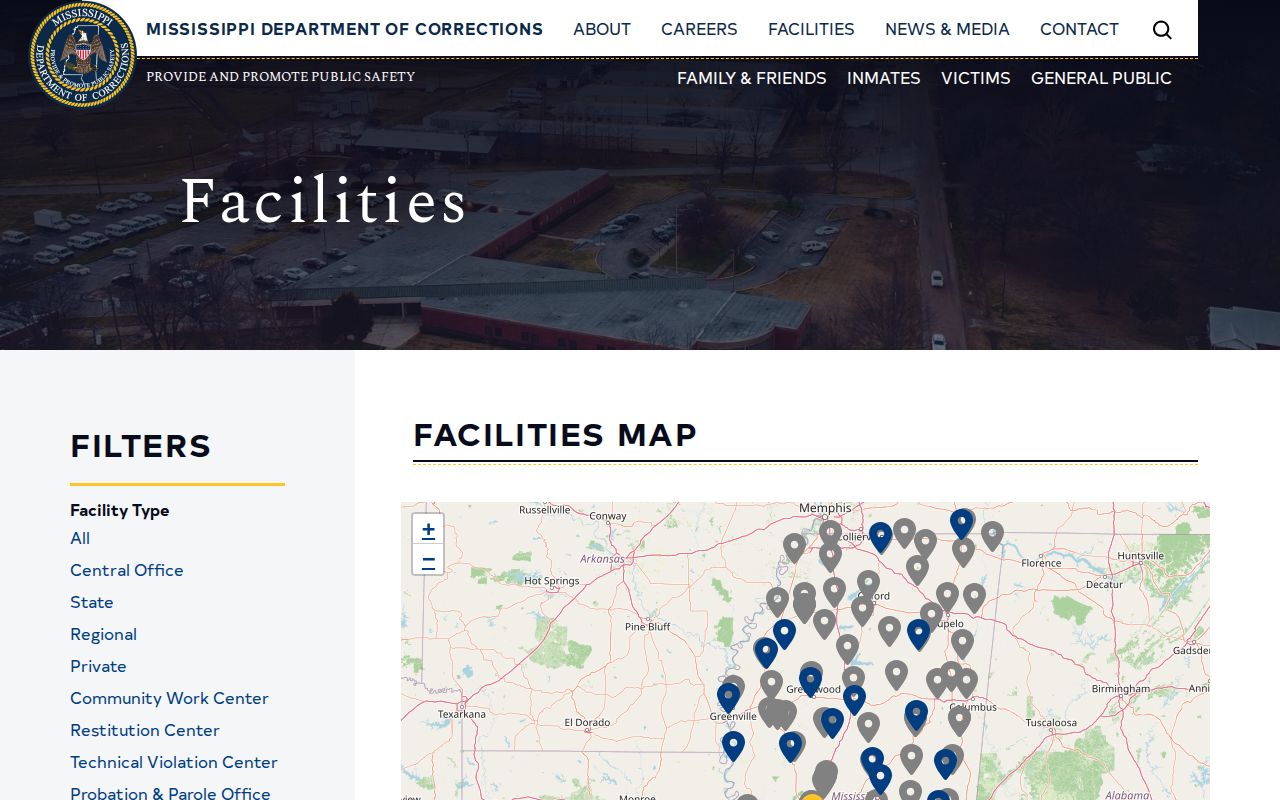
The directory supports classification, while an offender record or written MDOC document supplies the person-specific release facts.
Quitman CWC Tentative Dates
MDOC uses the exact public label “Tentative Release Date.” A tentative date can reflect sentence structure, jail credit received from the county of conviction, earned time, disciplinary changes, detainers, and other lawful factors. It can move. For eligible terms after the statutory cutoff described in section 47-5-138, earned time may reduce service within legal limits, but it is not a universal promise that every person serves the same share.
Residence approval and classification can also affect an ERS transition. The MDOC handbook says the department computes parole dates, ERS dates, tentative release or discharge dates, and maximum release dates. Parole eligibility has separate rules and does not equal Board approval. Even an approval can precede the actual physical exit while a plan, hold, or administrative step is resolved.
- Tentative release date
- MDOC's current projected date, subject to change.
- ERS
- Community placement in which the person retains inmate status and MDOC jurisdiction.
- Flat-time date
- A sentence endpoint shown in parole data, not always the date a person left a facility.
- Discharge
- The end of the sentence or supervision confirmed by the proper state record.
Note: Ask MDOC whether a stated date marks physical release, release to supervision, maximum sentence completion, or final discharge.
Quitman CWC Release Proof
Mississippi Code section 47-5-157 provides the strongest ordinary document for a state release or discharge. It directs MDOC to prepare a signed and sealed writing when an offender is entitled to discharge or is released on parole, pardon, or another lawful basis. The listed content can include the person's name, offenses, sentence term and date, sentencing county, any commutation, a practicable physical description, and a discharge plan.
A public search result still has value. It can locate the MDOC identity, show the last recorded placement, and give the tentative date used for follow-up. Yet it should not be enlarged into a claim the fields do not make. The research did not confirm a general public “Released” or “Discharged” label for every former MDOC inmate. Fully discharged people may require a records request.
When sources conflict, preserve each label and its date. “Location changed,” “eligible,” “parole granted,” “tentative release,” and “discharged” describe separate points in the process. Request a certification or correction from MDOC instead of choosing the most favorable date. That method gives a Quitman CWC release account a clear source and a defined meaning.
Note: A fully discharged former inmate may require a records request when no public MDOC result remains available.