
Quitman County Parole or Probation
Parole and probation both allow a person to live in the community under rules, but they begin in different ways. The Mississippi State Parole Board decides parole matters. MDOC calculates eligibility, holds the custody record, and supervises people in the community. Probation is imposed by a court and can follow a jail stay or begin without a state-prison term. A person may also be on Post-Release Supervision, often called PRS, under a sentencing order.
Earned Release Supervision is another status. ERS permits an eligible person to leave physical prison while retaining inmate status and MDOC jurisdiction. Intensive Supervision Program, sometimes called house arrest, is community custody. MDOC says only a judge may now sentence a person to ISP. These labels matter because a person can be physically out of a facility and still have an active sentence, reporting duties, or a future flat-time date.
| Status | How it begins | Best verification source |
|---|---|---|
| Parole | Conditional release approved through the state parole process | MDOC Parolee Search, Board record, and the local supervision office |
| Probation or PRS | A court order places the person under community supervision | Court docket and order, then MDOC community corrections |
| Earned Release Supervision | Eligible state custody changes to supervised release under MDOC | MDOC inmate location, time record, and supervision office |
| Discharge | The relevant term or jurisdiction ends by law or order | Written court or MDOC discharge record |
The key question is not just whether the person is outside a cell. Ask which status applies, which agency still has authority, and what date marks the next legal endpoint.
Check Quitman County Supervision Records
The public starting point is the MDOC Parolee Search. It accepts a first name, last name, MDOC ID, city, and county. A Quitman filter can narrow the list, but identity should be checked with the MDOC number, date of birth, physical details, and photograph. The result may show the county, supervising officer, and Flat Time Date. Flat time is the full sentence endpoint, not necessarily the date the person first left prison.
- Search the full name or MDOC ID, then add Quitman as the county only when the person is thought to be supervised locally.
- Compare stable identifiers. Do not identify a person from a photo or similar name alone.
- Record the source label exactly, including supervising county, officer, and Flat Time Date.
- Check the MDOC Inmate Search if ERS, a prison transfer, or current state custody may apply.
- Use the sentencing court for probation, PRS, revocation, or discharge orders, then ask the local office to route an operational question.
The official parolee form shows why name-only searches are incomplete. The MDOC source page presents separate name, ID, city, and county fields.
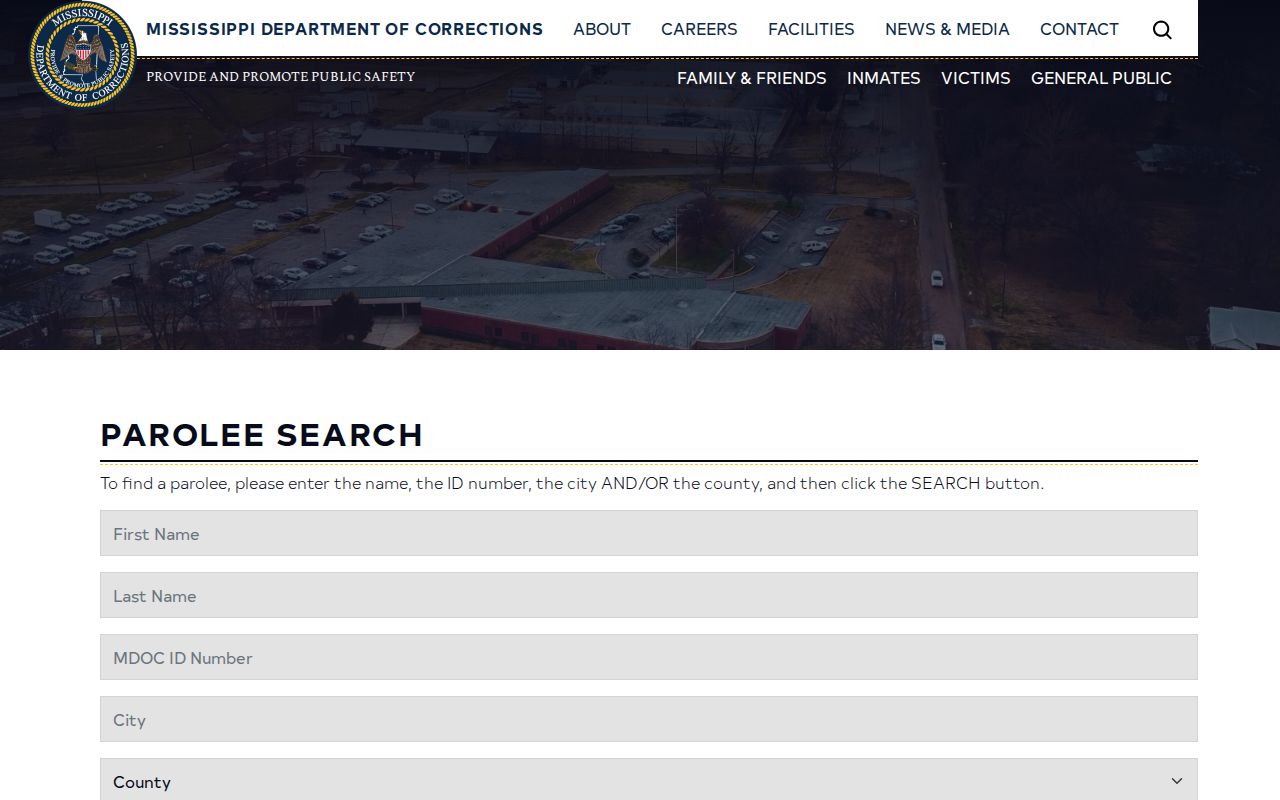
Those filters help locate a likely record, but the matched detail and issuing office remain the sources for status confirmation.
Important: No result does not prove that supervision ended. The person may be on probation, ERS, supervised elsewhere, fully discharged, listed under another spelling, or absent because of update timing.
Quitman County Supervision Office
Quitman County has a dedicated MDOC office in Marks. That local layer is important after a parolee or community-supervision result appears. It can route questions about the responsible office and help distinguish a local supervision matter from a Parole Board decision request. The research does not establish that private reporting details or confidential case facts will be released by telephone.
Quitman Probation & Parole Office
Community Corrections Director Tony P. Harris279 East Main Street
Marks, MS 38646
Phone: 662-326-8910
Fax: 662-326-8514
The official Quitman office listing confirms the office name, director, address, phone, and fax.
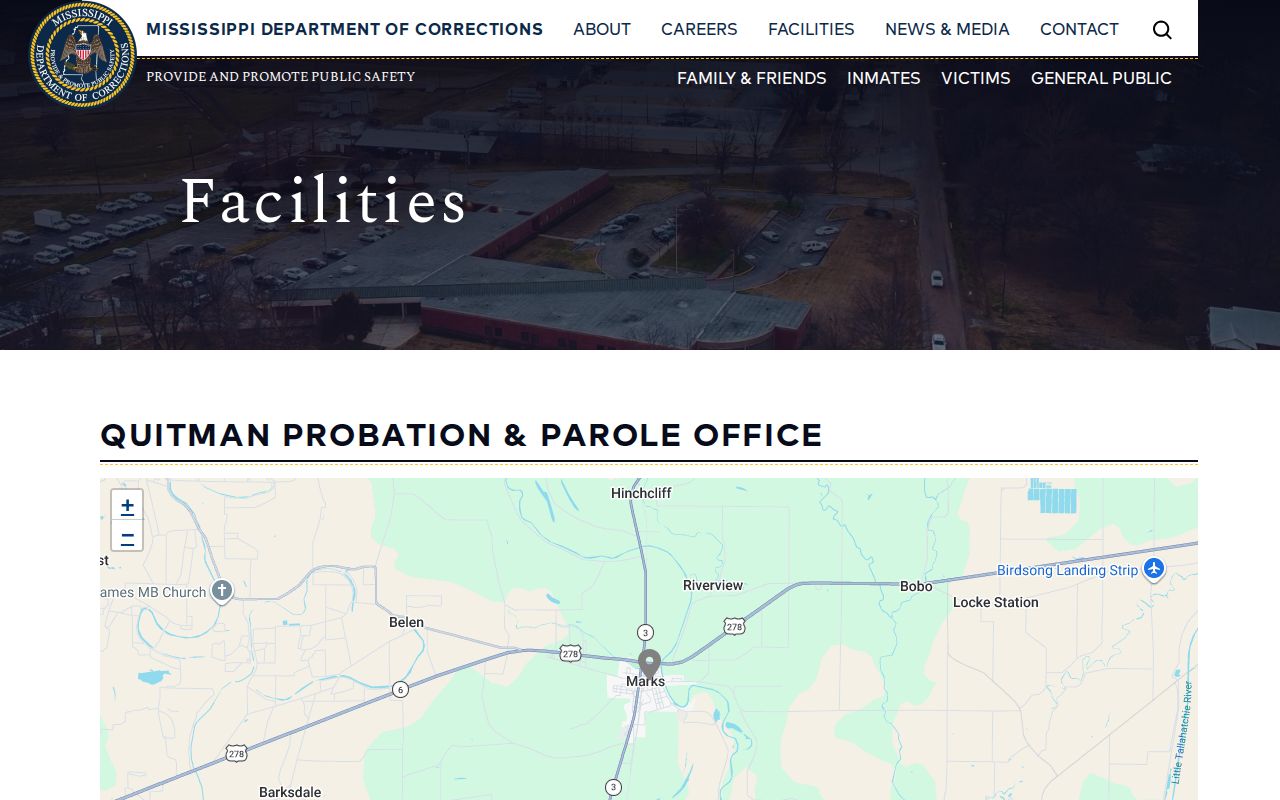
This office is the county-specific routing point once MDOC records indicate supervision in Quitman. Board grants, denials, and hearing records still belong with the Mississippi State Parole Board.
Note: Call before visiting because the research confirms the office contact details but does not establish public walk-in hours.
Quitman County ERS Transitions
A state record can place someone in an ERS location after physical prison confinement ends. That is not unconditional discharge. Under MDOC materials, the person keeps inmate status and remains within MDOC jurisdiction until the sentence expires or another lawful endpoint occurs. This distinction is especially relevant in Quitman County because the Community Work Center and Technical Violation Center can sit between institutional custody and community supervision.
The official MDOC ERS example displays a community-supervision location within the inmate system.
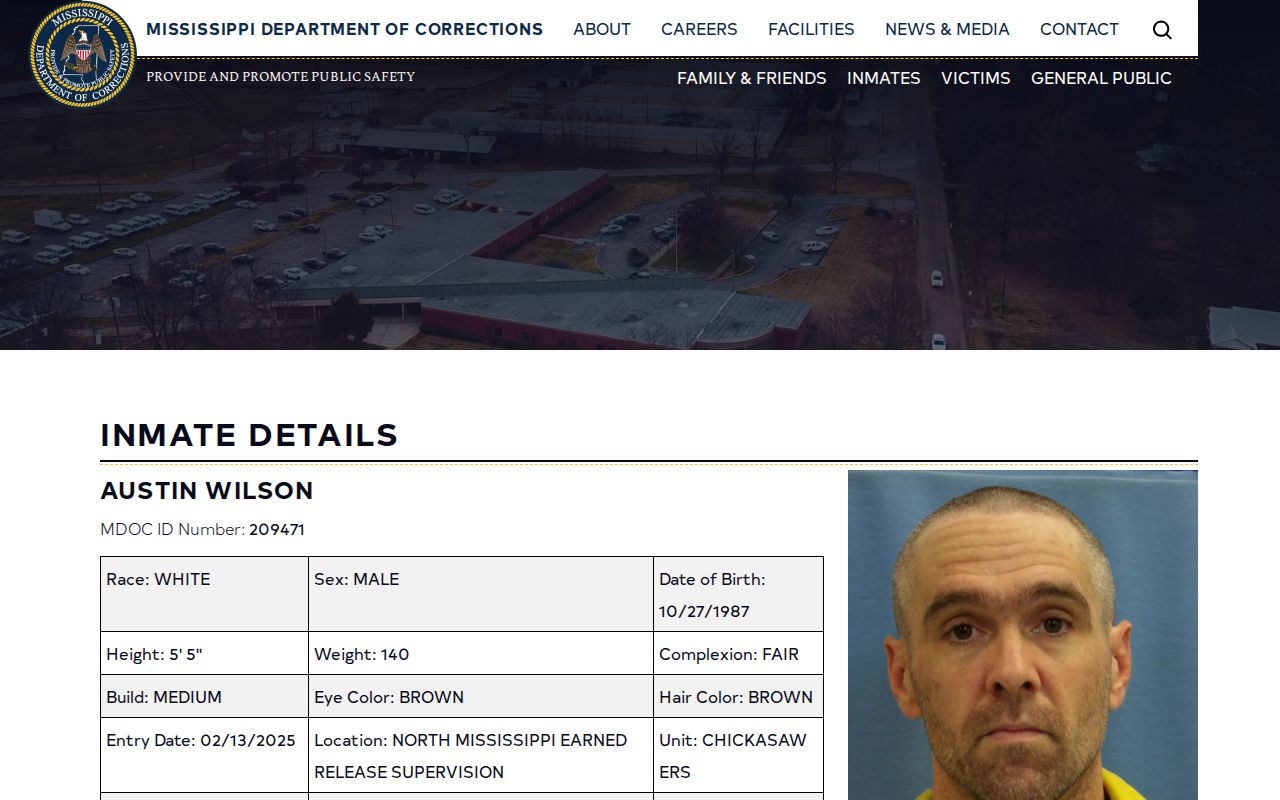
The example shows why the location field must be read with the sentence and supervision data. It proves how MDOC labels an ERS setting, not the status of any unrelated person.
When a person leaves the Quitman County Community Work Center or Technical Violation Center, ask MDOC whether the event was transfer, ERS, parole, a return to supervision, or full discharge. The county sheriff is not the custodian of these state transitions. A written MDOC release record gives firmer proof than a tentative date or a changed location.
Quitman County Supervision Violations
Conditions are the rules attached to community supervision. The exact terms come from the court, Parole Board, or supervising authority and should be read from the actual order. A violation allegation may lead to a warrant, hearing, added controls, or confinement. It does not by itself prove a new conviction. An absconder label generally means supervision authorities believe the person failed to remain available or compliant, but it does not show where the person is now held.
Quitman County has no verified public local absconder or warrant list. The Circuit Court MEC page lists case flags such as Bench Warrant Issued, Bench Warrant Returned, Probation Violation Pending, and PRS Violation Pending. Those flags are court case-management clues. They are not a statewide wanted-person search and do not prove present physical custody.
- Absconder
- A person supervision authorities allege is no longer reporting or available as required.
- Detainer
- A request or hold from another authority that can affect custody or release.
- Revocation
- A legal process that may withdraw community status after a proven violation.
- Flat Time Date
- The sentence endpoint shown in a parolee record, not necessarily the date prison custody ended.
- Discharge
- The formal end of the relevant sentence or supervision authority.
Confirm a warrant with the issuing authority and present custody with the agency that actually holds the person. The Quitman Technical Violation Center may create a confinement episode tied to supervision without creating a new underlying conviction.
Note: A violation flag describes a case status; it does not prove arrest, present confinement, or a new conviction.
Quitman County Parole Decisions
The Mississippi State Parole Board makes parole decisions, while MDOC calculates eligibility and manages custody and supervision. Under the state administrative rules, a hearing may proceed by file review, in person, by telephone, or by teleconference. A tentative hearing date is not a Tentative Release Date. A grant also is not the prison-exit timestamp because conditions, an approved residence or discharge plan, detainers, and processing can intervene.
No official public person-by-person hearing calendar or live decisions search was found. The State Parole Board agency page is the official entry point, but it does not supply that live lookup. For a current result, make a tailored records inquiry through the Board contact listed by MDOC. Historical Board minutes held by the state archives cover an older period and should not be used as a current outcome source.
After a grant, check the MDOC inmate location, the parolee record, and written release information. Once community supervision starts in Quitman County, the Marks office becomes the practical local contact. Eligibility means only that a person may enter the parole process. It does not guarantee Board approval or a set release day.
Quitman County Supervision Discharge
Supervision ends through a formal legal or administrative event, not merely because a public search stops returning a record. For probation or PRS, obtain the relevant sentencing, completion, or discharge order from the court. For MDOC parole or ERS, request the agency record that states whether physical release, flat-time completion, or full discharge occurred. These milestones may happen on different dates.
Mississippi law provides a written state release or discharge document under section 47-5-157. It can include the offender's name, offenses, sentence term and date, sentencing county, a physical description, and a discharge plan. MDOC's public-records portal is the stronger route when a public inmate or parolee search is unclear. A current status screen is useful, but a signed or certified agency record carries more weight for a past event.
The Quitman County released-person workflow on the home search and release-record page explains how to pair a supervision record with the jail, court, or MDOC event that ended physical custody. Keep the wording precise: released to parole, released to ERS, probation ordered, and fully discharged describe different states.
Note: Record the date, exact field label, and agency consulted so a later change can be reconciled without treating silence as proof.