
Quitman County Projected Release Meaning
MDOC uses the exact public label Tentative Release Date. It is a current sentence computation based on the information in the state record. It is prospective. It does not certify that a person walked out on that date, and it should not be renamed as an actual release date. The completed event is shown more firmly by an MDOC movement record or the written release or discharge document required by Mississippi law.
A pretrial Quitman County detainee usually has no computed MDOC date. The custody endpoint may turn on bond, dismissal, plea, sentencing, or another court order. Even an entered release order can precede physical departure while booking staff complete administrative steps or another hold is resolved. The sheriff or actual holding agency records the exit; the court file explains the legal authority.
For a sentenced state prisoner, MDOC calculates terms and establishes parole, ERS, tentative release or discharge, and maximum dates. Those labels can refer to different milestones. “Eligible,” “hearing scheduled,” “parole granted,” “released to ERS,” and “fully discharged” must not be collapsed into one date.
Find Quitman County Projected Release
Begin by identifying which system controls the sentence. The Quitman County sheriff handles county booking and can identify an outside holder, while MDOC controls state-corrections calculations. The Community Work Center, Technical Violation Center, and Mississippi State Penitentiary are state paths even when they are geographically tied to Quitman County.
- Ask whether the person is pretrial, serving a local jail sentence, or serving an MDOC sentence. Do not assume location from the arresting county.
- For state custody, open the MDOC Inmate Search and search by MDOC ID when possible, or by first and last name.
- Match identity with ID, birth date, physical details, photograph, offense, sentencing county, and sentence dates. Record the exact “Tentative Release Date” label.
- Read the current location and location-change date. An ERS location can mean physical release from prison while MDOC jurisdiction continues.
- For local custody, ask the sheriff and sentencing court how jail credit, the commitment, and the court order affect the calculation. No Quitman-specific county good-time rule was verified.
- For past release or full discharge, request the MDOC written record or the local custodian's actual release record.
The official MDOC inmate form shows the name and MDOC ID routes used for a state record.
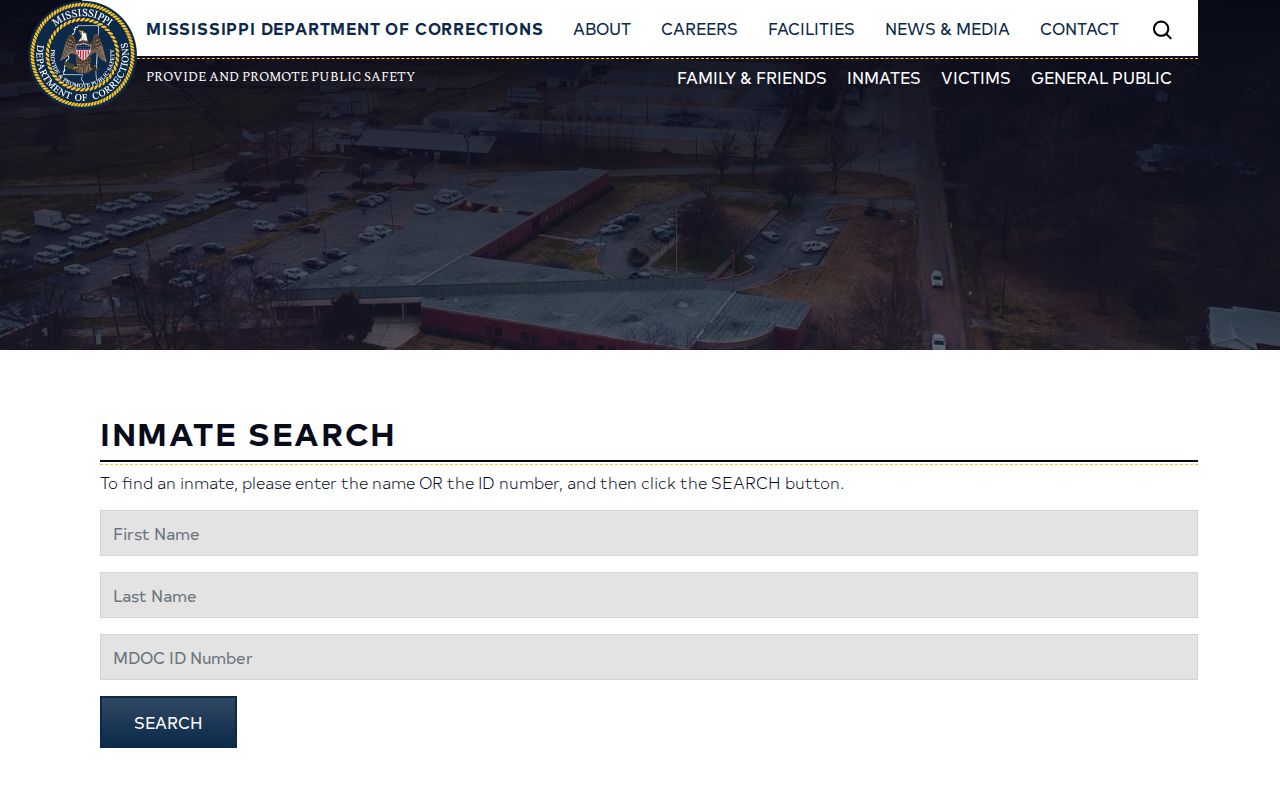
The form is only the entry point. Similar names require a careful identifier match before any date is connected to a person.
Quitman County MDOC Release Fields
The verified inmate detail contains more than a date. It can show the MDOC ID, physical description, photograph, entry date, location and unit, location-change date, total sentence information, offenses, counties of conviction, and sentence dates. Each field can explain whether a returned person is the right match and whether the tentative calculation relates to a Quitman conviction or a different case.
| MDOC field | How to read it |
|---|---|
| MDOC ID | Stable state identifier and the strongest public-search input |
| Entry Date | MDOC intake date, not automatically the sentence begin date |
| Location and Unit | Current state placement, including a possible ERS location |
| Location Change Date | Date the recorded placement changed, not necessarily full discharge |
| Sentence and Offense Blocks | Term, county, and dates that help explain the computation |
| Tentative Release Date | Prospective MDOC calculation subject to change |
The public field inventory did not confirm a general “Released” or “Discharged” label for every former inmate. A fully discharged person may not remain searchable. When the public result is absent or unclear, submit a focused request through the MDOC records portal for a release or discharge record and releasable time computation.
The official MDOC detail example displays the photo, location, offenses, and the precise Tentative Release Date label.
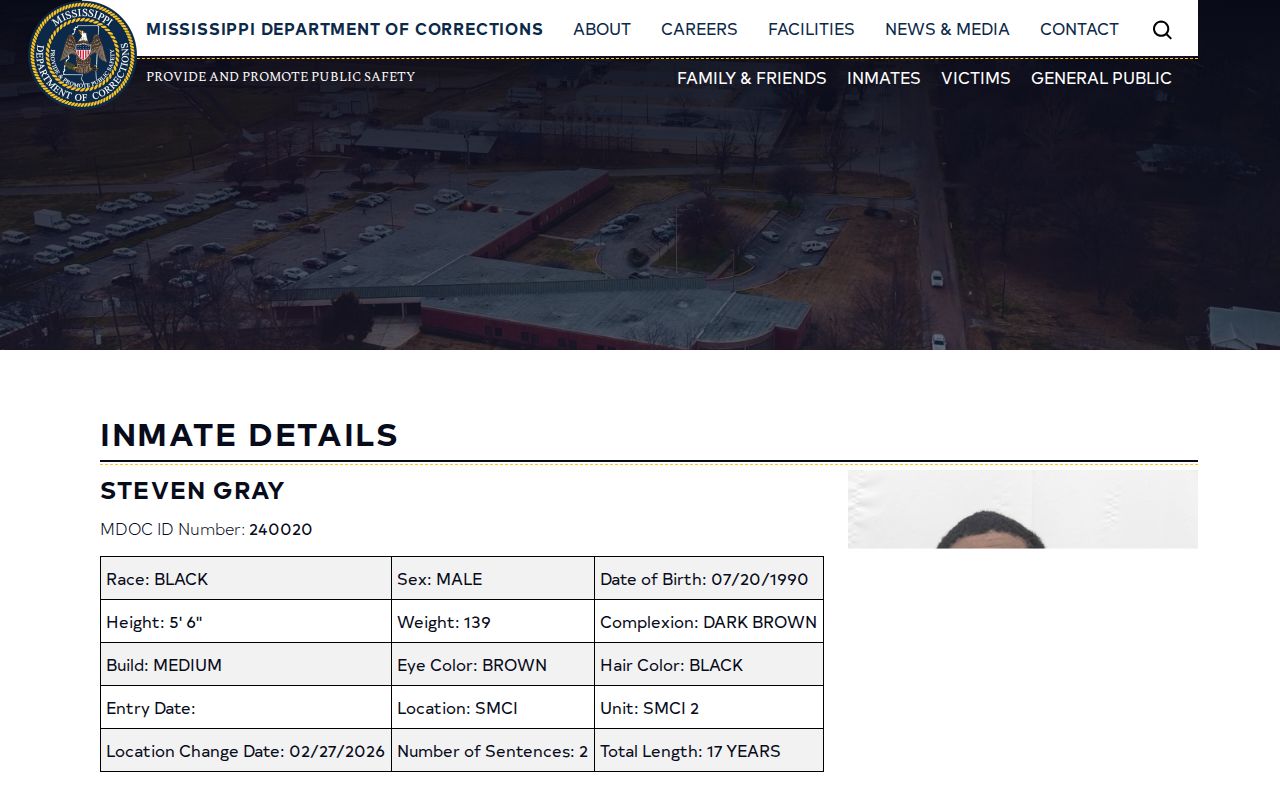
That image documents the portal's field design. It is not a claim about the status of another person and cannot replace a fresh search.
Note: Preserve MDOC's exact Tentative Release Date label and the date accessed whenever the public calculation is recorded.
Quitman County Earned Release Rules
For many Mississippi sentences after June 30, 1995, Mississippi Code section 47-5-138 permits 4.5 earned days for each 30 days served for compliant conduct and performance. The credit is capped at 15 percent of the sentence. This is the source of the common shorthand that a person may serve about 85 percent. It is not a universal formula and does not create a guaranteed release day.
MDOC first builds the sentence begin date. Eligible presentence jail time between the offense and the earliest sentence date may be credited after the county of conviction supplies the required information. Multiple sentences can run at the same time or one after another. Mandatory service terms, sentence amendments, and excluded offenses can change the result. Serious rule violations can cause earned-time forfeiture.
Release under section 47-5-138 generally means Earned Release Supervision until the sentence expires. The person stays an inmate under MDOC jurisdiction and is supervised in a way similar to parole. MDOC materials state that an approved in-state residence is required. Behavior, classification, and residence approval may stop a move to ERS on the displayed date.
Do not multiply a sentence by .85 and publish the answer. Jail credit, start dates, consecutive terms, offense-specific requirements, habitual status, exclusions, forfeiture, detainers, discipline, amended orders, and residence approval all require the actual record. The MDOC Inmate Handbook identifies several ERS disqualifiers and should be read with the current statute.
Why Quitman County Release Dates Change
A tentative date can move in either direction as the controlling record changes. The public search may also lag behind an agency action. Preserve the access date and exact label rather than reporting a screenshot as permanent fact.
| Factor | Possible effect | Where to verify |
|---|---|---|
| Jail credit or corrected start date | Changes credited time and sentence begin date | Sentencing court and MDOC time record |
| Concurrent or consecutive sentences | Changes which term controls the calculation | Judgment orders and MDOC computation |
| Earned-time forfeiture | May postpone the tentative date after serious discipline | MDOC classification and time record |
| Detainer or hold | May prevent community departure or cause transfer | MDOC and the requesting authority |
| Court amendment | Can alter sentence term, credit, or legal authority | Court docket and signed order |
| Residence approval | Can delay ERS or parole movement despite eligibility | MDOC and community corrections |
| Parole decision | May open a conditional release path but does not set the exit timestamp | Board record and MDOC release data |
Parole eligibility has its own offense- and date-specific rules under section 47-7-3. Earned time does not reduce the minimum service required for parole eligibility. Eligibility merely opens a consideration path. A Board grant can still depend on a discharge plan, residence approval, holds, and processing.
Note: The latest statute, sentencing order, and MDOC computation should control over a shortcut or an older portal capture.
Quitman County Lambert Release Transitions
Quitman County has two distinct MDOC operations at the same Camp B Road address in Lambert. The Quitman County Community Work Center is a state community-confinement operation. The MDOC facilities directory separately classifies the Technical Violation Center. Sharing an address does not make them one legal function.
A departure from the Community Work Center might be a transfer, parole, ERS, or sentence discharge. Leaving the Technical Violation Center may return a person to supervision after a violation confinement period. Neither event should be called a final release without the MDOC record. The sheriff's county-jail process is not the right source for these state movements.
Check the inmate location and change date first. Then use the parolee record and Quitman Probation & Parole Office when community supervision is indicated. For final proof, request the signed release or discharge document under section 47-5-157. Ask whether the supplied date is physical prison release, the start of supervised status, flat-time completion, or full discharge from MDOC jurisdiction.
This local split is why a projected date needs a custody label. The same calendar day may mark an institutional departure while supervision and inmate status continue.
Quitman County Parole Date Limits
Parole eligibility is not interchangeable with the Tentative Release Date. Current section 47-7-3 contains rules that vary by offense, sentence date, and legal category. For some qualifying offenses after June 30, 1995, the framework may use 25 percent or ten years for nonviolent offenses, 50 percent or twenty years for many violent offenses, and 60 percent or twenty-five years for certain named violent categories. Extensive exclusions and exceptions apply.
Section 47-7-18 generally requires a hearing for violent offenses, sex offenses, and geriatric cases. Other eligible people may move through a no-hearing route only if every statutory condition is met. Victim or law-enforcement action can trigger a hearing. A denial may identify corrective work and a later review. These provisions are too fact-specific for a date calculator.
A tentative hearing date is also distinct from release. MDOC determines eligibility dates, the Board decides parole, and MDOC manages the later custody transition. A person can receive a grant but remain in prison while a plan, residence, detainer, or administrative step is unresolved. Confirm a pending status through the Quitman County VINELink inmate search process, then obtain the actual event record from MDOC.
Note: A parole grant can precede the physical exit, so verify both the Board action and MDOC movement record.
Quitman County Jail Sentence Dates
A local jail sentence that never transfers to MDOC may not appear in the state inmate search. Call the Quitman County Sheriff's Office to identify the actual housing agency because state law allows the county to contract for inmate housing outside the county. Ask the sentencing court for the commitment and any order awarding jail credit. Then ask the custodian how those records and its lawful policy produced the date.
No verified Quitman-specific county good-time rule, weekend-release practice, release hour, or public release-date calculator was found. Do not transfer the MDOC 15-percent earned-time framework to a local sentence without authority. If a court order authorizes release, obtain the sheriff or holding facility's movement record to establish when custody truly ended and whether the event was community release or transfer.
The Quitman County release-record search covers the county, state, court, and federal paths for confirming a completed event. A projected date is useful for deciding when to check, but a later custodian record supplies the event, timestamp, disposition, and destination.